This blog was updated on a daily basis for about two years, with those daily entries ceasing on December 31, 2013. The blog is still active, however, and we hope that people stopping in, who find something lacking, will add to the daily entries.
The blog still receives new posts as well, but now it receives them on items of Wyoming history. That has always been a feature of the blog, but Wyoming's history is rich and there are many items that are not fully covered here, if covered at all. Over time, we hope to remedy that.
You can obtain an entire month's listings by hitting on the appropriate month below, or an individual day by hitting on that calendar date. Use 2013 for the search date, as that's the day regular dates were established and fixed.
Alternatively, the months are listed immediately below, with the individual days appearing backwards (oldest first).
1842 Alfred Packer, Colorado cannibal, born in Allegheny County, Pennsylvania.
1860 Tom Horn born in Scotland County Missouri.
1865 Platte Bridge Station renamed Ft. Caspar in honor of the late Caspar Collins, who had lost his life at the Battle of Platte Bridge Station earlier that year.
1877 Inventor Thomas A. Edison unveiled the phonograph.
1887 The Wyoming Central Railway opened its line between Douglas and Glenrock, thereby extending its rail service to the state line.
1895 The Federal District Court, sitting in Cheyenne, held that the Treaty of 1868 exempted Indians from the State's game laws. The decision would later be reversed.
1910 August Malchow defeated by Peter Jensen of Omaha, the "Battling Dane", in a fight at the Kirby Opera House in Sheridan. See September 25 for more on Malchow.
On this day in 1919, the newspapers were reporting that Bill Carlisle was headed for a location that was the archtype of destination for regional bands. . . some twenty years prior.
Well, it was a romantic notion. Wyoming in 1919 wasn't the Wyoming of 1899, or even 1909, no matter how much the thought of a wild flight to the Hole In The Wall might have been fancied the imagination of a people for whom that region had been an impenetrable criminal fortress only a couple of decades prior.
In 1919, the territory was still wild in many ways. Indeed, the first decade of the 20th Century saw an ongoing range war in the form of a cattlemen v. sheepmen killings. As late as the latter part of the first decade of the 20th Century a criminal escapee simply disappeared forever.
But by the same token, by 1919 the criminal sanctuary no longer was one. There was no more Hole In The Wall Gang. Most of the former members of that group were dead, in prison, or reformed. Following the Tipton train robbery by The Wild Bunch, the authorities were no longer willing to tolerate the lack of law enforcement that allowed it to continue to exist and were willing to expend the resources necessary to penetrate it. Prior to that happening, the badmen dispersed. Some would return, and as late as the 00s, but they weren't hitting trains.
Carlisle was.
Buffalo Creek Canyon, December 2019.
Indeed, part of the appeal of the Carlisle story is that he was already an anachronism, in his own time. In 1919, the year after the Great War had ended, a war which had featured aircraft and submarines and mass violence on a mass scale, Carlisle was out on his own, in the vast countryside, raiding trains, badly.
People were sort of rooting for him.
Even as they knew, he'd be caught.
1940 Ernest Hemingway and Martha Gellhorn were married in Cheyenne. The wedding took place at the Union Pacific Depot dining room. Attribution: Wyoming State Historical Society.
1943 Goshen Vounty's harvest declared a success due to the efforts of immigrant Mexican laborers and Prisoners of War. Attribution. Wyoming Historical Society's history calendar.
1950 A DC3 (C-47) airplane crashed into Mount Moran, killing all 21 persons on board. The plane was flying in poor weather.
1957 The Department of Defense announced that F.E. Warren AFB would be the nation's first ICBM base.
1975 Dick Cheney assumes the position of White House Chief of Staff under Gerald Ford.
1837 Republic of Texas Secretary of State Robert A. Irion recommended that Texas grant copyrights.Attribution: On This Day.
1866 First national convention of the Grand Army of the Republic. The GAR would be represented by local chapters throughout the US, including Wyoming, leaving memorials in at least Casper and Basin, Wyoming.
1869 First issue of the Wyoming Tribune published in Cheyenne.
1886 Thomas Moonlight appointed Territorial Governor of Wyoming.
1903 Tom Horn hanged for the murder of Willie Nickell. He was actually hung with the rope he made, like the popular proverb, as he braided the rope while serving time waiting for his execution.
1920 An emergency landing strip was bladed near Laramie. This was not, however, Brees Field. Attribution: Wyoming State Historical Society.
1945 Mindful of an industry that had become significant in the state even well before World War One, Gov. Lester Hunt urged western governors to cooperate in selling the West to tourists who would follow the end of World War Two. Attribution. Wyoming History Calendar.
Elsewhere:
1868 Ft. Omaha founded in Nebraska.
1871 John and David McDougall become the first farmers in Alberta.
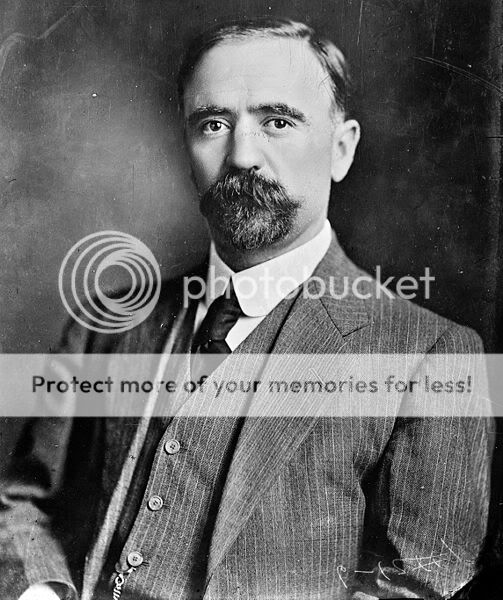
1910 Francico Madero declares a revolution in Mexico. Madero's
revolution was a success in that Diaz fled the country in 1911. He
died in France in 1915, but Madero died well before him, as he was
assassinated by those loyal to Gen. Huerta, who had no sympathy with
Madero's views.
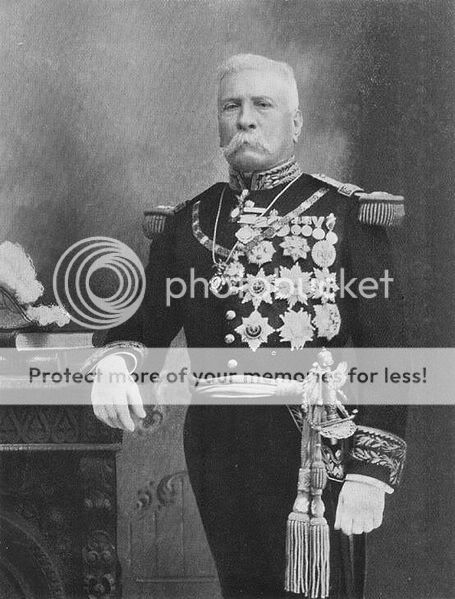
Diaz's
long life was one that featured many interesting turns. He joined the
Mexican army in the first instance in order to fight against the
United States in the Mexican War. He lead guerrillas against Santa Ana
upon his return to Mexico. He fought the French with Juarez but was
an opponent, sometimes a revolutionary, against Juarez thereafter. He
came to rule Mexico in 1877 by popular election, and ironically stepped
down after one term having run on that platform. He ran again in 1884
and remained in power until the revolution. While he ultimately was
toppled in a revolution, his authoritarian rule of Mexico was the first
real period of peace in Mexico since the revolution against Spain, and
the country generally prospered. Had he stepped down, as he had
indicated he was willing to do, he would be well remembered today.
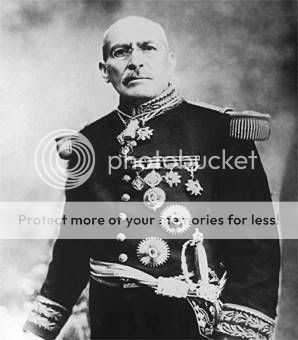
Heurta
would die in El Paso Texas, in exile, in 1916, where he was under
house arrest after having been detected negotiating with the Germans
for arms in violation of the Neutrality Act.
Of
note here, the involvement in the US in the Mexican Revolution proved
to be almost inevitable. The border region was chosen by participants
in both sides as a place of refuge, to include both the humble and the
conspiratory. Madero, Villa, and Huerta all chose the US as a place of
refuge, and a place to base themselves in the hope to return to Mexico
and achieve power. Tensions on the US border started with the
revolution being declared in 1910, and as early as the first day of the
revolution Mexican authorities were assuring the US not to have
worries. Tensions would last long after World War One, and the cross
border action that started before the war would continue on briefly
after the war.
The Wyoming National Guard, like that of
every other state, would see border service in this period, first being
mustered to serve on the border in 1915. National Guard service
involved nearly constant active duty from March 1915 through World War
One.
As Wyomingites were headed towards Thanksgiving this week, they learned
that the giant surprise British attack at Cabrai had been launched. The
battle would feature British tanks in a major way.
And Pancho Villa was back in the headlines for the success of his old occupation, as he battled Carranza near the US border.
Carlisle was being reported as sassy and successful on this day in 1919. In fact, his attempt at robbing a Union Pacific passenger train near Medicine Bow failed due to his own scruples. . . he couldn't rob soldiers, and he'd been wounded disarming a passenger.
Rumors were circulating that he'd sent a bragging telegram. I'm not that familiar with the details of this story, but I don't believe that he did.
He had been lost track of, that's true.
But I don't believe that he'd made it to Casper.
The press was giving him greater abilities than he had.
American Thanksgiving is a fairly late Thanksgiving to start with. As has been noted here on earlier posts, this holiday is much less unique to the US than Americans think it is. Most nations do it earlier, however.
It has moved around in the US case. The Library of Congress's "Wise Guy" posts, summarize it as follows:
Is it time to buy the turkey? In 1939, it would have been difficult to plan your Thanksgiving dinner for 12.
Today, Thanksgiving is celebrated on the fourth Thursday of November. But that was not always the case. When Abraham Lincoln was president in 1863, he proclaimed the last Thursday of November to be our national Thanksgiving Day. In 1865, Thanksgiving was celebrated the first Thursday of November, because of a proclamation by President Andrew Johnson, and, in 1869, President Ulysses S. Grant chose the third Thursday for Thanksgiving Day. In all other years, until 1939, Thanksgiving was celebrated as Lincoln had designated, the last Thursday in November.
Then, in 1939, responding to pressure from the National Retail Dry Goods Association to extend the Christmas shopping season, President Franklin D. Roosevelt moved the holiday back a week, to the next-to-last Thursday of the month. The association had made a similar request in 1933, but at that time, Roosevelt thought the change might cause too much confusion. As it turns out, waiting to make the change in 1939 didn't avoid any confusion.
At the time, the president's 1939 proclamation only directly applied to the District of Columbia and federal employees. While governors usually followed the president's lead with state proclamations for the same day, on this year, 23 of the 48 states observed Thanksgiving Day on November 23, 23 states celebrated on November 30, and Texas and Colorado declared both Thursdays to be holidays. Football coaches scrambled to reschedule games set for November 30, families didn't know when to have their holiday meals, calendars were inaccurate in half of the country, and people weren't sure when to start their Christmas shopping.
After two years of confusion and complaint, President Roosevelt signed legislation establishing Thanksgiving Day as the fourth Thursday in November. Roosevelt, recognizing the problems caused by his 1939 decree, had announced a plan to return to the traditional Thanksgiving date in 1942. But Congress introduced the legislation to ensure that future presidential proclamations could not affect the scheduling of the holiday. Their plan to designate the fourth Thursday of the month allowed Thanksgiving Day to fall on the last Thursday in five out of seven years.
This was the last year of the confusion, and the split dates. Sarah Sundin, on her blog, noted:
So what about Wyoming in 1941? Did we do Democratic Thanksgiving or Republican Thanksgiving this year?
Today.
Indeed, it's a little surprising, at least in a modern context, but Wyoming recognized today as the Thanksgiving Holiday for 1941. While Wyoming had a Republican legislature, and a Republican Governor, Nels H. Smith, serving his single term, it followed the Federal lead.
Lots of Americans were having their second military Thanksgiving.
Troops training in the field gathered around cook who is cooking turkey's with a M1937 field range.
Holidays in large wartime militaries, and while the US was not fully at war yet, this really was a wartime military, are a different deal by definition. The service does observe holidays and makes a pretty good effort at making them festive, but with lots of people away from home without wanting to be, they're going to be a bit odd. Some troops, additionally, are going to be on duty, training, or deployed in far off locations.
As noted above, we've included a wartime photo of a cook in what is undoubtedly a staged photo cooking two turkeys in a M1937 field range, a gasoline powered stove.
They continued to be used through the Vietnam War.
Holiday or not, talks resumed in final earnest between the United States and Japan, with Japanese representatives presenting this proposal to the United States
1. Both the Governments of Japan and the United States undertake not to make any armed advancement into any of the regions in the South?eastern Asia and the Southern Pacific area excepting the part of French Indo-China where the Japanese troops are stationed at present.
2. The Japanese Government undertakes to withdraw its troops now stationed in French Indo-China upon either the restoration of peace between Japan and China or the establishment of an equitable peace in the Pacific area.
In the meantime the Government of Japan declares that it is prepared to remove its troops now stationed in the southern part of French Indo-China to the northern part of the said territory upon the conclusion of the present arrangement which shall later be embodied in the final agreement.
3. The Government of Japan and the United States shall co-operate with a view to securing the acquisition of those goods and commodities which the two countries need in Netherlands East Indies.
4. The Governments of Japan and the United States mutually undertake to restore their commercial relations to those prevailing prior to the freezing of the assets.
The Government of the United States shall supply Japan a required quantity of oil.
5. The Government of the United States undertakes to refrain from such measures and actions as will be prejudicial to the endeavors for the restoration of general peace between Japan and China.
The Germans captured Rostov on the Don in Russia and slowed the British advance in North Africa.
1942 NHL abolishes regular season overtime until World War II is over.
Today is recognized as World Men's Day in many nations.
1868 The Bear River City Riot occurred in which parties supporting a lynched murder suspect and those supporting the lynching rioted. The town Marshall bravely stood his ground against both sides, but there was serious destruction in the town and sixteen people died. Cavalry was dispatched from Ft. Bridger to restore order.
1909 George Sabin sentenced for Second Degree Murder for his part in the Spring Creek Raid. He escaped on December 25,1913, while on a work gang in Basin, and was never recaptured.
The sentencing is remarkable and significance as it effectively meant an end to private warfare over sheep in Wyoming, and it also meant that conventional justice had come to the Big Horn Basin, where previously juries would not convict in these circumstances. This reflected in part the horror of the Spring Creek assault, but also the fact that the Basin was now closer to the rest of the state, having been connected some time prior by rail.
Robbing a train as soon as you escape the pen for robbing trains does seem like a pretty bad idea. At least one paper wondered if it was actually him.
You have to wonder what Carlisle was thinking. How did he plan on getting away with this?
By this time, it was also clear that the proposed Versailles Peace Treaty was in real trouble in the U.S. Senate.
Indeed, it was in so much trouble that on this day in 1919, the Senate voted to reject the Treaty, with Republican opposition to the League of Nations being a major cause of that vote.
There would be a couple of more attempts, but the United States never did ratify the treaty, passing instead a peace treaty with Germany later that adopted much of it, but not all of it. The US would not join the League of Nations.
1980 Heaven's Gate, a widely panned at the time, highly expensive, cinematic interpretation of the Johnson County War premiered. The film has since gained some respect (I've never seen it) but it was not the success hoped for by its makers.
Almost every popular work based upon the Johnson County War is a serious failure in some regards, with almost all of them being simplistic in some fashion and failing nearly completely to understand the complexities of what they try to depict. While I have not seen this film, and have no real interest in doing so, I would be very surprised if it was much different.
1986 Zane Dean Beadles of the Denver Broncos born in Casper.
2009 The Coe East wing at Wyoming University was officially dedicated.
1832 William Hale born in New London Iowa. He would serve as Territorial Governor from July 1882 until his death in 1885.
1869 Governor John A. Campbell proclaimed the day "a day of
Thanksgiving and Praise."
1883 John (Manual Felipe) Phillips (Cardoso) died in Cheyenne Wyoming. He is famously remembered as the civilian who rode 236 miles from Ft. Phil Kearny to Ft. Laramie following the Fetterman Fight. Phillips is an interesting character and was born in the Azores in 1832, which he left at age 18 on a whaler bound for California in order to pan for gold. He was a gold prospector across the West for 15 year. He was actually at Ft. Phil Kearny as a party of miners he was left had pulled into the fort in September of 1866.His famous ride is somewhat inaccurately remembered, as he did not make the entire ride alone, as often imagined, but instead rode with Daniel Dixon. Both men were paid $300.00 for their effort. After this event Phillips switched occupations to that of mail courier, and then he became a tie hack in Elk Mountain Wyoming, supplying rails to the Union Pacific. In 1870 he married and founded a ranch at Chugwater, Wyoming. He and his wife sold the ranch in 1878, and he moved to Cheyenne where he lived until his death.
1883 The United States and Canada adopted a system of standard time zones.
1886 Chester A. Arthur, the 21st president of the United States, died in New York at age 56.
1889 The first train to arrive in Newcastle arrives. Attribution: Wyoming State Historical Society.
1890 Francis E. Warren assumes the office of U.S. Senator from Wyoming. He was Wyoming's first Senator.
1902 Frederick Remington drew pictures of dedication of Irma Hotel, Cody. Courtesy of Wyoming State Archives via the Wyoming State Historical Society's calendar.
Particularly if you hang out in areas of the net where the things are somewhat pedantic, you'll see the claim that World War One "didn't end" on November 11, 1918, because the Versailles Treaty was signed in May, 1919.
Cheyenne newspaper noting the American and Allied march into Germany and the surrender of the German fleet. This paper also notes the horrible death toll of the Spanish Flu Epidemic.
Well, dear reader, armies don't march into the "heart" of a nation that isn't defeated. Nor does a non defeated nation, in a time of war, turn its ships over to the enemy.
Laramie newspaper noting much the same, but also noting one of the ways in which wars change things. . . air mail was expanding following the close of the war. . . and of course the war had changed airplanes much.
No, while you'll occasionally see that, it's clear German was not only on its knees in November 1918, it was a defeated nation in Revolution.
The Casper paper ran as its headline the reunification of Alsace with France. . .something that a defeated nation does is give up territory.
And Germany was getting smaller, as this headline noted.
The U.S. Senate passed the Willis-Campbell Act on this day in 1921 prohibiting physicians from proscribing beer as a medical remedy. They could still prescribe hard alcohol and wine.
On the same day, the British suspended new ship construction in light of progress at the Washington Naval Conference talks. And Roscoe Arbuckle's trial was proceeding.
Arbuckle with his defense team and brother.
Marshall Foch visited New York City's statue of Joan d'Arc.
Marshal Ferdinand Jean Marie Foch with mineralogist George Frederick Kunz at a ceremony held at the Joan of Arc statue in New York City. Standing at the right, is Anna Vaughn Hyatt Huntington, sculptor of the Joan of Arc statue, and Jacqueline Vernot holding flowers.
The Soviet Union, which was going to have an economy based on pure ownership by the proletariat of the means of production, figured out that banks were a necessity and crated a state bank. The Soviet economy was collapsing.
1943 The Wyoming Department of Education released the results of a survey revealing that the state was short 70 teachers, no doubt the result of teachers having joined the armed forces during World War Two. Attribution. Wyoming History Calendar.
2023. Pine Ridge Reservation declared a state of emergency due to a rise in crime, with the same to last until January 1, 2025.
1835 The people of Cincinnati, Ohio raised funds for two cannons for Texas that
became known as the "twin sisters." Attribution: On This Day.
1880 Rain In The Face surrendered with 500 followers at Ft. Keogh.
1906 Eleven people were killed in a head on train collision near Azusa, Wyoming. The collision was caused by a mistake in a train order in a telegraph, and most of the men killed were railroad employees in a day coach.
1910 First annual conference of Wyoming clergy held. Attribution: Wyoming State Historical Society.
American infantrymen crossing the Armistice Line at Etain, November 17, 1918.
American troops were marching into Germany while some were denying that a prostrate Germany was prostrate. And at the same time a proposal was made to erect a monument to the Great War dead from Natrona County in front of the courthouse.
That courthouse is now gone. Maybe that monument was erected and is gone now, but as far as I'm aware, the only outdoor memorial to Natrona County's World War One veterans came up in the 2000s, although there were early memorials of other types, those being a trench mortar in Veteran's Park, Caissons at Washington Park, and a swimming pool named in memory of a lost soldier of World War One at the same park.
1968 NBC outraged football fans by cutting away from the final minutes of a game to air a TV special, "Heidi," on schedule.
1970 Douglas Engelbart receives the patent for the first computer mouse.
2008 The vampire romance movie "Twilight" premiered in Los Angeles, an event destined in future years to be ranked with the Vandals sacking Rome as a really bad day for Western Civilization.
2012 From the Governor's office:
CHEYENNE, Wyo. -- Governor Matt Mead released the following statement regarding the refugee issue:
"No
state should have to endure the threat of terrorists entering our
borders," Governor Mead said. "The President needs to make certain an
absolutely thorough vetting system is in place that will not allow
terrorists from Syria or any other part of the world into our country.
In light of the horrific terrorist attacks in Paris, I have joined other
governors in demanding the refugee process be halted until it is
guaranteed to provide the security demanded by Wyoming and United States
citizens. I have written the President (letter attached) to make it
known Wyoming will not accept a lackluster system that allows terrorists
to slip through the cracks."
Governor Mead and other governors have a conference call with the President this afternoon.
I don't usually editorialize in these comments (although I do occasionally), but it's hard not to see this as a political reaction. Given the lack of infrastructure for it, it is doubtful at best that any Syrian refugees would have been resettled in Wyoming. A person can debate whether any terrorist might enter the US in this fashion, but a person is also bound to consider the added humanitarian crisis that failing to address this situation will cause, and the added likelihood of that potentially inspiring violence in the future.
534 A second and final revision of the Codex Justinianus is published. Compiling Roman law proved to be a difficult chore due to the many different versions of it in regards to any one particular topic. While Roman law provides comparatively little basis for modern American law, outside of Louisiana, it was not wholly without influence to some degree. The codification of the Roman law in Roman times provided the basis, later for the codification of French law under Napoleon.
1887 Legendary photographer of Wyoming, Charles Belden, born in California.
1878 The Commissary at Fort Fetterman listed the supplies on hand as being: 195 lbs. of turkey, 140 of codfish, and 11 lbs. of cherries. Date: Attribution: Wyoming Historical Calendar.
The Laramie Boomerang correctly noted that the United States had crossed
back into Mexico, but just right across the border. This was something
that the US would end up doing in a worried fashion for years, showing
that while the Punitive Expedition might be over, armed intervention, to
a degree, in Mexico, was not.
At the same time, the press was really overemphasizing US combat action
in Europe. The US wouldn't really be fighting much for weeks and weeks.
And the on again, off again, hope that the Japanese would commit to ground action was back on again.
Meanwhile, in Lander, things were getting really ugly. "German sympathizers" were being made to kiss the flag.
That probably didn't boost their loyalty any.
Villas expanding plans were also being noted. And, also, The Temptation
Rag, a film, was being reported on, on the front page, something that
takes a true scandal to occur now.
1942 Wyoming Senator Harry H. Schwartz introduced bill to protect Western stockmen from wartime eminent domain losses.
1945 USS Laramie decommissioned.
1973 President Richard M. Nixon signed the Alaska Pipeline measure into law.
1982 The Jahnke murder occurred in Cheyenne, in which Richard Janke Jr., aided by his sister, killed his abusive father. The murder was later the basis of a television movie entitled Right to Kill.
1993 A magnitude 3.5 earthquake occurred about 65 miles from Sheridan.
2002 Tom Farris, who had been born in Casper Wyoming, and who had played football for three years in the National Football League following World War Two, died.
2015 In keeping with a request from President Obama, Governor Mead ordered flags in the state to fly at half mast until sundown, November 19, in honor of the dead of the recent terrorist attack in Paris.
An attempt at a pact on the Mexican border appeared to fall through, to the frustration of the U.S. delegates.
A train was robbed in Kansas City, Missouri. The paper referenced Bill
Carlisle, the famous Wyoming train robber who is usually credited with
the last train robbery in the US. This story would obviously cast doubt
on that claim.
In Cheyenne there was dissension on the rabbi that had been serving there.
Residents of Cheyenne were reading today about a rumored, and totally
false, revival of the fortunes of Czar Nicolas II. The Czar, they read,
was crowned Czar. . . again. . . . in Siberia.
Not so much.
Russia was descending into complete chaos however. That was real enough.
And so was Villa's revival right on the border with Texas. His troops had in fact taken Ojinaga.
Having gone from desperate in March 2015, to pursued the rest of 2015
and 2016, he was back in top form and contesting for control of northern
Mexico, to American consternation and concern, once again. And now
while we had a major war on our hands.
1919. William Carlyle, train robber, escaped from the Wyoming State Penitentiary.
1921 A truck used by John J. Pershing in the Great War was donated to the Wyoming State Museum.
1926 The National Broadcasting Co. debuted nationwide with a radio network of 24 stations.
1937 The first US Congressional session in air-conditioned chambers took place.
1940 The first 75,000 men were called to armed forces duty under peacetime conscription. This wast the first time in U.S. history in which there had been a peacetime draft, excluding annual militia musters.
1943 Harmonica player Larry Adler played at the University of Wyoming. Adler was a well known harmonica player.
1890 Joseph M. Carey elected as the first U.S. Senator for Wyoming. F. E. Warren elected to a second senator for Wyoming. At this time, the Legislator appointed the Senators, rather than the electorate electing them.
Carey was an 1864 graduate of the University of Pennsylvania College of Law, and became U.S. Attorney for the Territory of Wyoming in 1869. He was on the Territorial Supreme Court from 1871 to 1876, when he left that field to become a rancher, founding a significant early ranch in Natrona County Wyoming, the CY. He served as governor from 1890 to 1895, being Wyoming's first state governor, and then again from 1911 to 1915, during which time he supported the Progressive Party campaign for President of Theodore Roosevelt.
Gov. Carey in his second term at the launching of the USS Wyoming.
1897 An earthquake damaged the Grand Central Hotel in Casper.
Native American Jim Thorpe played his first professional football game in a 16–0 Canton Bulldogs' loss to the Massillon Tigers.
Thorpe would win Olympic gold medals, and played professional football baseball and basketball. He was he most versatile athlete of all time. He served as a merchant marine in World War Two, but descended into alcoholism and died nearly penniless in 1953 at age 65.
Booker T. Washington died at age 59 in Tuskegee, Alabama of overwork, Bright's disease and congestive heart failure.
Pancho Villa's forces were back in the headlines. . . with combat right on the US border.
A battle significant enough that it was not only pushing the
Carranzaistas out of a disputed town. . . it pushed World War One and
the Russian Revolution aside a bit as well.
Not that both didn't also show up. Include a hopeful headline that the Bolsheviks were going down in defeat.
As odd as it may seem, it was this day, November 14, 1918, when the Germans surrendered in Africa.
It took that long for news to reach British and German forces in Zambia, where they were still engaged in hostilities up until that time.
Paul von Lettow Vorbeck, commander of the German forces in Africa who would return to Germany a hero in March 1919 and actually be allowed to lead his returning troops through the Brandenburg Gate in full German African regalia. He went on to be an anti Nazi monarchist right wing politician in the Reichtag and was reduced to poverty during the war and lived, for a time after it, on packages from his former enemies Smuts and Meinertzhagen, although is fortunes recovered before he died in 1964.
The same day was one for sort of odd headlines, or at least oddly spelled headlines, in the Casper newspaper.
1921 World Champion wrestler Jack Taylor of Wyoming lost the title in Boise to a Russian wrestler. Attribution: Wyoming State Historical Society.
Taylor was actually a Canadian, but he was living in Wyoming at the time. He had just been defeated noted wrestler Jack Pasek at the Iris in Casper on October 31 in a three-hour match, so he was on a losing streak.
Taylor had originally hailed from Ontario and would return to Canada in later years, retiring to Edmonton, a city which is interestingly frequently compared to Casper, although for reasons that are unclear to me.