The date isn't known with precision. Only that it occurred in August. But this date, August 20, is used as the usual date for the event when a slaver arrived off the port at Port Comfort, Virginia, carrying 20 to 30 African who were held in bondage and sold into slavery.
The event marked the return of the English to being a slave owning society. Slavery had been abolished by the Normans after conquering Anglo Saxon Britain in 1066 and while it's common to see claims of other types of servitude, including involuntary servitude, equating with slavery, they do not. Slavery is unique.
And late European chattel slavery, which commenced with the expansion of European powers into African waters and into the Americas, was particularly unique and in someways uniquely horrific.
Slavery itself was not introduce to African populations by Europeans; they found it there upon their arrival, but they surprisingly accommodated themselves to participating in it very rapidly. Europeans had been the victims of Arab slavers for a long time themselves, who raided both for the purposes of acquiring forced labor, and fairly horrifically, for forced concubinage, the latter sort of slave having existed in their society for perhaps time immemorial but which had been licensed by Muhammad in the Koran. Arab slave traders had been quite active in Africa early on, purchasing slaves from those who had taken them as prisoners of war, an ancient way of dealing with such prisoners, and the Europeans, starting really with the Portuguese, seemingly stepped right into it as Europe's seafaring powers grew.
Having waned tremendously in Europe following the rise of Christianity, European powers somehow found themselves tolerating the purchase and transportation for resale of Africans for European purchasers by the 15th Century, with most of those purchasers being ultimately located in the Americas.
The English were somewhat slow to become involved. It wasn't clear at first if slavery was legal under English Common Law and the English lacked statutory clarification on the point such as had been done with other European powers. Early English decisions were unclear on the point. However, starting with the 17th Century, the institution worked its way into English society, even as opposition to it grew from the very onset.
The importation of slaves to English populations was not limited to North American, but it was certainly the absolute strongest, in the English speaking world, in England's New World colonies. While every European seafaring power recognized slavery by the mid 17th Century, the really powerful markets were actually limited to the Caribbean, English North American, and Portuguese Brazil. European slavery existed everywhere in the New World, and no country with colonies in North America was exempt from it, but it was strongest in these locations.
And slavery as reintroduced by Europeans was uniquely abhorrent. Slavery, it is often noted, has existed in most advanced and semi advanced societies at some point, but slavery also was normally based in warfare and economics nearly everywhere. I.e., it was a means of handling conquered armies, conquered peoples, and economic distress. The word "servant" and "slave" in ancient Greek was the same word for this latter reason. In eras in which resources were tight and there was little other means of handling these situations, slavery was applied as the cruel solution.
But it wasn't raced based. The slavery that the Europeans applied was. Even Arab slavery, which was ongoing well before the Europeans joined in and continued well after, was not based on race but status. If a lot of Arab slaves were black in the 17th Century, that was mostly due to an environment existing which facilitated that. Earlier, a lot of forced concubine Arab slaves, for example, were Irish. The Arabs were equal opportunity slavers.
Europeans were not. European slaves were nearly always black, and even examples of trying to note occasions in which Indians were held as slaves are very strained. And because it was raced based, it took on a unique inhuman quality. Slavery wasn't justified on the basis that the slaves were prisoners of war that had fallen into that state, but that the state was better than death, nor were they held on the basis that they had sold themselves or had been sold into servitude due to extreme poverty, and that was better than absolute destitution. It wasn't even justified on a likely misapplied allowance granted by Muhammad for slaves that were held due to war, and could be used for carnal purposes, reinterpreted (I'm guessing) for convenient purposes. It was simply that they were black and, therefore, something about that made them suitable for forced labor.
And forced labor it was. Servants in the ancient world had often been servants and even tutors. While it did become common in North America to use slaves as household domestics, most slaves in North America performed heavy agricultural labor their entire lives. It was awful and they worked in awful conditions.
And it tainted the early history of the country in a way that's ongoing to this day. With opposition to its reintroduction right from the onset, but the late 18th Century it was clear that its abhorrent nature meant it was soon to go out everywhere. Almost every European country abolished it very early in the 19th Century, which is still shockingly late. It was falling into disfavor in the northern part of the British North American by the Revolution, in part because agriculture in the North was based on a developed agrarian pattern while in the South the planter class engaged in production agriculture (making it ironic that the yeoman class would be such a feature of the American south). The pattern of agriculture had meant that there were comparatively few slaves in the north. This is not to say it was limited to the South, however. Slavery even existed in Quebec.
With the Revolution came the belief that slavery would go out, but it didn't. By that time the American South had a huge black slave population. Slavery would if anything become entrenched in the South, where most of the American black population lived, and it would take the worst war in the nation's history to abolish it. So horrific was that war that even today the descendants of those who fought to keep men slaves sometimes strain the confines of history to find an excuse for what their ancestors did. And following their Emancipation, the nation did a poor job of addressing the racism that had allowed it to exist. It wasn't until the second quarter of the 20th Century that things really began to change, with the Great Migration occurring first, followed by a slow improvement in status following World War One, followed by a rapid one after World War Two that culminated in the Civil Rights Era of the 1950s, 60s, and 70s.
But the stain of slavery lingers on in innumerable ways even now. Having taken to slavery in 1619, and having tolerated it for over two hundred years thereafter, and having struggled with how to handle the residual effects of that for a century thereafter, we've still failed to really absorb the impact of the great sin of our colonial predecessor.
I am happy to join with you today in what will go down in history as the greatest demonstration for freedom in the history of our nation.
Five score years ago, a great American, in whose symbolic shadow we stand today, signed the Emancipation Proclamation. This momentous decree came as a great beacon light of hope to millions of Negro slaves who had been seared in the flames of withering injustice. It came as a joyous daybreak to end the long night of captivity.
But one hundred years later, the Negro still is not free. One hundred years later, the life of the Negro is still sadly crippled by the manacles of segregation and the chains of discrimination. One hundred years later, the Negro lives on a lonely island of poverty in the midst of a vast ocean of material prosperity. One hundred years later, the Negro is still languished in the corners of American society and finds himself in exile in his own land. So we have come here today to dramatize an shameful condition.
In a sense we've come to our nation's Capital to cash a check. When the architects of our republic wrote the magnificent words of the Constitution and the Declaration of Independence, they were signing a promissory note to which every American was to fall heir.
This note was a promise that all men, yes, black men as well as white men, would be guaranteed the unalienable rights of life, liberty, and the pursuit of happiness.
It is obvious today that America has defaulted on this promissory note insofar as her citizens of color are concerned. Instead of honoring this sacred obligation, America has given the Negro people a bad check; a check which has come back marked "insufficient funds."
But we refuse to believe that the bank of justice is bankrupt. We refuse to believe that there are insufficient funds in the great vaults of opportunity of this nation. So we have come to cash this check- a check that will give us upon demand the riches of freedom and the security of justice.
We have also come to this hallowed spot to remind America of the fierce urgency of now. This is no time to engage in the luxury of cooling off or to take the tranquilizing drug of gradualism.
Now is the time to make real the promises of democracy. Now is the time to rise from the dark and desolate valley of segregation to the sunlit path of racial justice. Now is the time to lift our nation from the quicksands of racial injustice to the solid rock of brotherhood. Now is the time to make justice a reality for all of God's children.
It would be fatal for the nation to overlook the urgency of the moment. This sweltering summer of the Negro's legitimate discontent will not pass until there is an invigorating autumn of freedom and equality. Nineteen sixty-three is not an end, but a beginning. Those who hope that the Negro needed to blow off steam and will now be content will have a rude awakening if the nation returns to business as usual. There will be neither rest nor tranquility in America until the Negro is granted his citizenship rights. The whirlwinds of revolt will continue to shake the foundations of our nation until the bright day of justice emerges.
But there is something that I must say to my people who stand on the warm threshold which leads into the palace of justice. In the process of gaining our rightful place we must not be guilty of wrongful deeds. Let us not seek to satisfy our thirst for freedom by drinking from the cup of bitterness and hatred. We must forever conduct our struggle on the high plane of dignity and discipline. We must not allow our creative protest to degenerate into physical violence. Again and again we must rise to the majestic heights of meeting physical force with soul force.
The marvelous new militancy which has engulfed the Negro community must not lead us to a distrust of all white people, for many of our white brothers, as evidenced by their presence here today, have come to realize that their destiny is tied up with our destiny. And they have come to realize that their freedom is inextricably bound to our freedom. We cannot walk alone.
And as we walk, we must make the pledge that we shall march ahead. We cannot turn back. There are those who are asking the devotees of civil rights, "When will you be satisfied?"
We can never be satisfied as long as the Negro is the victim of the unspeakable horrors of police brutality.
We can never be satisfied as long as our bodies, heavy with the fatigue of travel, cannot gain lodging in the motels of the highways and the hotels of the cities.
We cannot be satisfied as long as the Negro's basic mobility is from a smaller ghetto to a larger one.
We can never be satisfied as long as our chlidren are stripped of their selfhood and robbed of their dignity by signs stating "for whites only."
We cannot be satisfied as long as a Negro in Mississippi cannot vote and a Negro in New York believes he has nothing for which to vote.
No, no, we are not satisfied, and we will not be satisfied until justice rolls down like waters and righteousness like a mighty stream.
I am not unmindful that some of you have come here out of great trials and tribulations. Some of you have come fresh from narrow jail cells. Some of you have come from areas where your quest for freedom left you battered by the storms of persecution and staggered by the winds of police brutality. You have been the veterans of creative suffering. Continue to work with the faith that unearned suffering is redemptive.
Go back to Mississippi, go back to Alabama, go back to South Carolina, go back to Georgia, go back to Louisiana, go back to the slums and ghettos of our northern cities, knowing that somehow this situation can and will be changed. Let us not wallow in the valley of despair.
I say to you today, my friends, so even though we face the difficulties of today and tomorrow, I still have a dream. It is a dream deeply rooted in the American dream.
I have a dream that one day this nation will rise up and live out the true meaning of its creed: "We hold these truths to be self-evident; that all men are created equal."
I have a dream that one day on the red hills of Georgia the sons of former slaves and the sons of former slave owners will be able to sit down together at the table of brotherhood.
I have a dream that one day even the state of Mississippi, a state sweltering with the heat of injustice, sweltering with the heat of oppression, will be transformed into an oasis of freedom and justice.
I have a dream that my four little children will one day live in a nation where they will not be judged by the color of their skin but by the content of their character.
I have a dream today.
I have a dream that one day down in Alabama, with its vicious racists, with its governor having his lips dripping with the words of interposition and nullification, that one day right down in Alabama little black boys and black girls will be able to join hands with little white boys and white girls as sisters and brothers.
I have a dream today.
I have a dream that one day every valley shall be exhalted, every hill and mountain shall be made low, the rough places will be made plain, and the crooked places will be made straight, and the glory of the Lord shall be revealed, and all flesh shall see it together.
This is our hope. This is the faith that I will go back to the South with. With this faith we will be able to hew out of the mountain of despair a stone of hope. With this faith we will be able to transform the jangling discords of our nation into a beautiful symphony of brotherhood.
With this faith we will be able to work together, to pray together, to struggle together, to go to jail together, to stand up for freedom together, knowing that we will be free one day.
This will be the day when all of God's children will be able to sing with new meaning, "My country 'tis of thee, sweet land of liberty, of thee I sing. Land where my fathers died, land of the Pilgrims' pride, from every mountainside, let freedom ring."
And if America is to be a great nation, this must become true. So let freedom ring from the prodigious hilltops of New Hampshire. Let freedom ring from the mighty mountains of New York. Let freedom ring from the heightening Alleghenies of Pennsylvania.
Let freedom ring from the snow-capped Rockies of Colorado. Let freedom ring from the curvaceous slopes of California. But not only that; let freedom ring from the Stone Mountain of Georgia. Let freedom ring from Lookout Mountain of Tennessee.
Let freedom ring from every hill and molehill of Mississippi. From every mountainside, let freedom ring.
And when this happens, and when we allow freedom ring, when we let it ring from every village and every hamlet, from every state and every city, we will be able to speed up that day when all of God's children, black men and white men, Jews and gentiles, Protestants and Catholics, will be able to join hands and sing in the words of the old Negro spiritual, "Free at last! Free at last! Thank God Almighty, we are free at last!"
Rev. Martin Luther King, August 28, 1963.
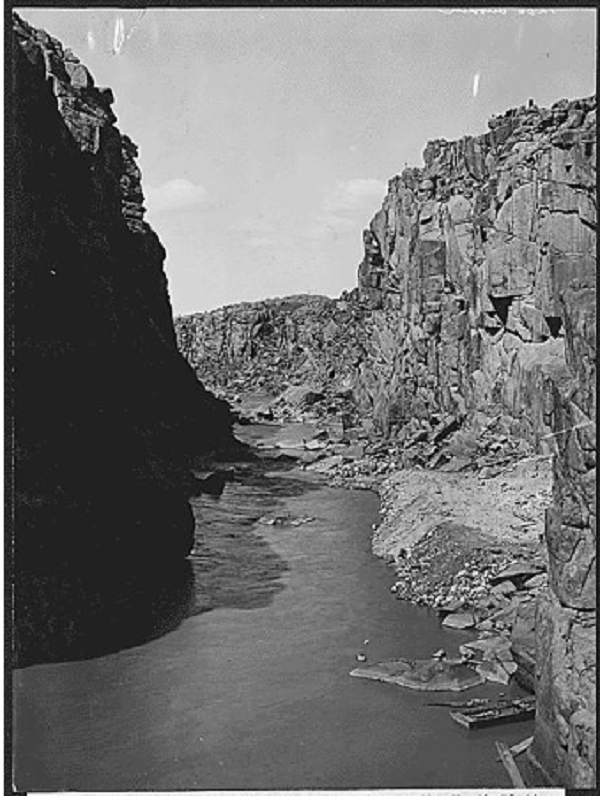
1804 Sergeant Charles Floyd of the Corps of Discovery died. He was the only member of the Corps of Discovery to die during the existence of the Corps, which was of course formed and existed for the special purpose of crossing the newly acquired territory of Louisiana.
1870 Camp Stambaugh, near South Pass, established. Attribution: Wyoming State Historical Society.
1877 Elements of the 1st and 2nd Cavalry unsuccessfully engage the Nez Perce at Camas Creek, Idaho. The battle is regarded as a Nez Perce victory.
1908 Cheyenne electric railway commenced operations.
1910. Disastrous fires strike in Montana. 3,000,000 acres of land burned in two days. Taft, DeBorgia, Henderson and Haugan Montana were destroyed and over 80 people died.
1913 Only pool hall in county closed in Torrington. Attribution: Wyoming State Historical Society.
1945 The War Production Board ceases most of its activities.
1946 Restrictions on American truck production, started during World War Two, come to an end.
1988 "Black Saturday" of the Yellowstone fire, in which more than 150,000 acres were burned in a firestorm. Attribution: On This Day.
2014 Following on this item posted this morning:
Today In Wyoming's History: History in the Making: The 2014 Primary Election: The 2014 Wyoming Primary occurred yesterday. The election was one of the most remarkable in recent history in that it featured the near co...and noting the statewide results just linked in, there are a couple of remarkable items in the results.
One is that Tea Party candidates for state office did remarkably poorly nearly everywhere. This would suggest that the Tea Party elements that appeared to be gaining a great deal of ground prior the Primary, and which had come to dominate some county organizations, are not nearly as popular as would have been previously thought. Indeed, it would appear that their strength at the county level is probably due to their enthusiastic members rather than numbers, and when it comes to voting, the base isn't there.
Additionally, it's interesting how poorly Cindy Hill did everywhere. Hill was the center of the controversy which gave rise to Tea Party activism this primary but she seems to have had very little support amongst actual GOP voters. Indeed, Tea Party voters went for Taylor Haynes in much greater numbers.
That's interesting too in that while Haynes did not achieve anywhere near the votes he would have needed in order to topple Governor Mead, he himself is fairly well liked. This says a lot for Wyoming voters and suggests that the old Wyoming GOP may still be there for the most part. Haynes is from Laramie County, which is generally unpopular in general elections, he isn't actually originally from here, and he's black. Voters shouldn't have weighed any of that in their considerations, and they appear to have not done so, to their credit. Native Hill was proved to be unpopular and Haynes did much better. As Haynes may not actually hold views as extreme as he stated during this election, it'll be interesting to see if he has a future in Wyoming GOP politics.
History in the Making: The 2014 Primary Election
The election was one of the most remarkable in recent history in that it featured the near complete collapse of the state's Democratic Party combined with a very real split in the GOP. In effect, therefore, this was the actual election for many offices.
The demise of the Democratic Party was fairly apparent in the election, although it's been the case for at least one prior election cycle. The Democrats could not field candidates for every state office, although they did field serious candidates for some, and filled others with candidates who are so poorly known they have no realistic chance of success. Probably the Democrat that has the best chance of election in November is Mike Cellabos who is running for Secretary of Education, although his chances probably decreased last night with the victory of Jillian Balow for that position in the GOP.
Balow's victory is emblematic of what occurred yesterday, as she handily defeated a slate of other candidates including one that associated herself with Tea Party Gubernatorial candidate, Cindy Hill, the present Secretary of Education. For a year the GOP has been in absolute turmoil in the state as Tea Party elements took on the GOP establishment and essentially created two parties within the one. The Primary was a struggle for which side would prevail within the GOP. Tea Party elements ran candidates for every position, including two candidates for the Governor's seat against the incumbent Governor, Matt Mead, who had drawn their ire for signing SF104 into law. That bill had greatly reduced the responsibilities of the Secretary of Education and was seen as an attack on Hill, who later fared poorly in a Legislative review of her actions in that position. The law was found to be unconstitutional by the Wyoming Supreme Court but not before the controversial Cindy Hill, who is the present occupant of the office, declared for the Governorship herself. In local elections Tea Party adherents ran against other incumbants, including two such efforts locally here in Natrona County.
This caused the election to be rather peculiar to long term Wyoming residents and featured such oddities as threats to arrest Federal officers within Wyoming and threats to "take back" the Federal Domain. In the end it turned out that the GOP rank and file that turned out for the election (the turnout was somewhat low) was much more mainstream than the Tea Party branch and Tea Party candidates went down in defeat. Mead fared well in the primary and his victory in the general election against Democrat Pete Gosar is nearly assured. Hanynes, who gathered some attention with his first run four years ago, in a campaign that was less extreme, and Hill, both went down in defeat with their combined totals amounting to less than 50% of the vote. As noted, Balow handily defeated the candidate who campaigned on her association with Hill. In two local races, while they were surprisingly close, incumbents turned back Tea Party challengers.
It'll be interesting to see how this develops long term. Effectively the Wyoming 2014 election is practically over, save for a few local races and, as noted, the race for Secretary of Education. Tea Party elements have effectively been given a rebuke by the GOP rank and file. Candidates who would have attracted the more conservative, but less Tea Party like, elements of the GOP, like Gubernatorial candidate Taylor Haynes and Secretary of State candidate Buchanan might take this election as a lesson that they can appeal to the true conservative elements of the party but should not campaign on extreme positions which are not likely to appeal to the general electorate and obviously do not appeal to the GOP rank and file.
The lesson for Democrats, of course, is a repeat of the one they received some years ago that they need to find a Wyoming center and campaign on it. The complete collapse of the Democrats under former Democratic governor Dave Freudenthal, who was not responsible for it, but who somewhat is symbolic of it in that he had to distance himself from the party from time to time, should have taught them that. Now the party struggles to even find candidates and has what amounts to only two serious ones, Gosar and Cellabos, with only Cellabos having any realistic chance of a victory. Those candidates aren't tainted with the national party, but the local Democratic Party has steadfastly refused to learn that, and continues to back positions that are all but fatal for anyone with a "D" behind their name.